
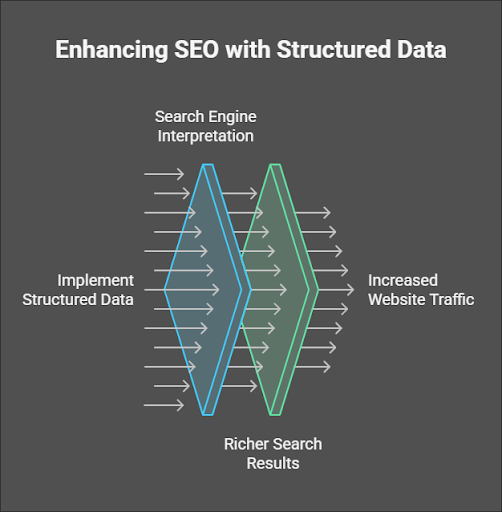
In today’s digital landscape, search engine optimization has evolved beyond keyword placement and meta descriptions. As AI-powered search and answer engines (AEO) reshape how users find information, one critical element often gets overlooked: structured data.
Your structured data is the foundation upon which your entire search strategy stands. Without it, you’re leaving visibility, click-through rates, and customer engagement on the table—no matter how compelling your content or how strategically placed your keywords.
What Is Structured Data, and Why Does It Matter Now?
Structured data is code that tells search engines exactly what your content means. It’s like providing a translator between your website and search algorithms, ensuring they understand not just what you’re saying, but what you’re talking about.
For years, structured data was viewed as a nice-to-have enhancement. But 2024-2025 has changed that equation entirely. With the rise of AI-powered search features, knowledge panels, and answer engines like Perplexity and ChatGPT integrating web search, search engines are becoming increasingly reliant on well-organized, semantically clear data.
Search engines now prioritize websites that speak their language—and that language is structured data.
The AEO Connection: Why This Matters More Than Ever
Answer Engine Optimization (AEO) represents the next frontier in search visibility. Unlike traditional SEO, where you’re competing for a position on a results page, AEO is about getting your content cited and pulled into AI-generated answers.
Here’s the problem: AI engines can’t properly credit or surface your content if they can’t clearly understand what it is. Structured data solves this by:
- Clarifying content context – Marking whether you’re discussing a product, article, event, or organization
- Providing data accuracy – Ensuring prices, dates, ratings, and other key information are correctly extracted
- Enabling rich answers – Making your content eligible for featured snippets and AI-powered answer integrations
- Building trust signals – Demonstrating authoritative information architecture to both search engines and AI systems
Without structured data, your brilliantly written article might be invisible to answer engines entirely.
Practical Steps to Strengthen Your Structured Data Strategy
Ready to audit and improve your structured data? Here’s how to get started:
- Conduct a Structured Data Audit Review your website for existing schema markup. Use Google Search Console and Schema.org‘s validator to identify gaps. Look specifically at your highest-performing pages—if they lack structured data, that’s your priority area.
- Identify Your Core Content Types Determine which schema markup applies to your business. E-commerce sites need ProductSchema. News publishers need ArticleSchema. B2B service providers benefit from LocalBusinessSchema and ServiceSchema. Match your content to the appropriate markup types.
- Implement Strategic Schema Markup Start with high-impact areas: product pages, blog articles, testimonials, FAQs, and local business information. Tools like Yoast SEO, Rank Math, and Schema.org make implementation manageable, even for non-technical teams.
- Test and Validate Regularly Use Google’s Rich Results Test and Schema.org‘s validator to ensure your markup is error-free. Invalid schema can hurt more than help, so consistency is crucial.
- Monitor Performance Data Track how structured data correlates with your search visibility metrics. Monitor impressions, click-through rates, and AI-generated answer citations over time. Adjust your strategy based on what’s working.
- Stay Updated on Schema Evolution Schema standards evolve as search engines refine their needs. Subscribe to Schema.org updates and SEO industry resources to stay ahead of changes that could impact your visibility.
Common Structured Data Mistakes to Avoid
Even well-intentioned implementations can backfire. Watch out for:
- Outdated or irrelevant schema – Using markup that doesn’t accurately reflect your content
- Incomplete data – Partial schema implementations that create confusion rather than clarity
- Keyword stuffing in structured data – Treating markup as another opportunity for keyword stuffing (search engines penalize this)
- Neglecting mobile structured data – Assuming desktop markup is enough (AEO relies on mobile-optimized data)
The Bottom Line
Your content, keywords, and user experience matter. But without structured data, you’re operating with limited visibility in a search landscape that’s rapidly evolving toward AI-powered answers.
The organizations winning in 2025 and beyond aren’t just creating great content—they’re making that content discoverable at every layer of the search ecosystem. Structured data is how you do that.
Don’t let your search strategy be undermined by incomplete data architecture. The time to audit and strengthen your structured data isn’t next quarter—it’s now.
Ready to Audit Your Structured Data Strategy?
Download our comprehensive Structured Data Implementation Checklist and take control of your search visibility. This actionable guide walks you through every step, from audit to implementation, so you can ensure your content is optimized for both traditional search and the AI-powered answer engines reshaping the industry.
[Download the Checklist →] Checklist
Questions about implementing structured data for your business? Makeni Bent Digital Consulting specializes in SEO and AEO strategy for growing organizations. Let’s talk about how to strengthen your search visibility.